
Rotobrush Air Duct Cleaning in Newport News: A Homeowner’s Guide
Rotobrush isn’t a brand of clean. It’s a specific mechanical system, a rotating brush head paired with simultaneous vacuum extraction, and whether it’s the right method for your ducts depends on what those ducts are actually made of. Most homeowners searching for Rotobrush air duct cleaning in Newport News are asking the right question for the wrong reason: they’ve heard the name and want to know if it’s what will be used, without knowing what it does at the duct wall. This guide closes that gap.
What Rotobrush Actually Does Inside Your Ducts
The name gets treated like a badge, as if any company using a Rotobrush is automatically doing a better job. The machine matters, but only when it’s run correctly and the results are verified with a camera. Here’s the mechanical reality, without the marketing language.
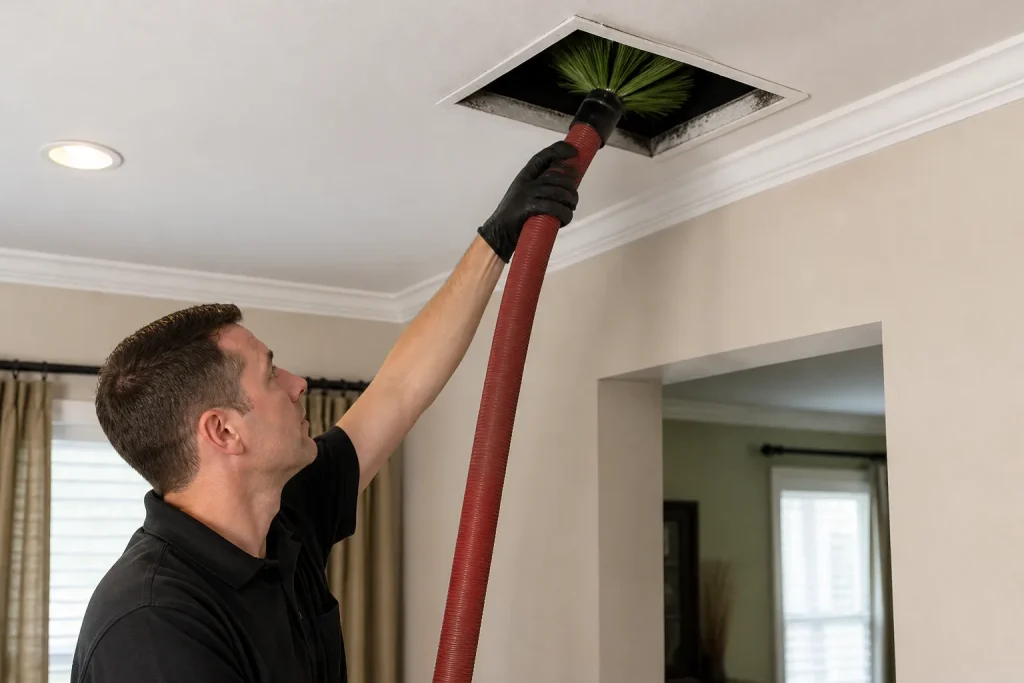
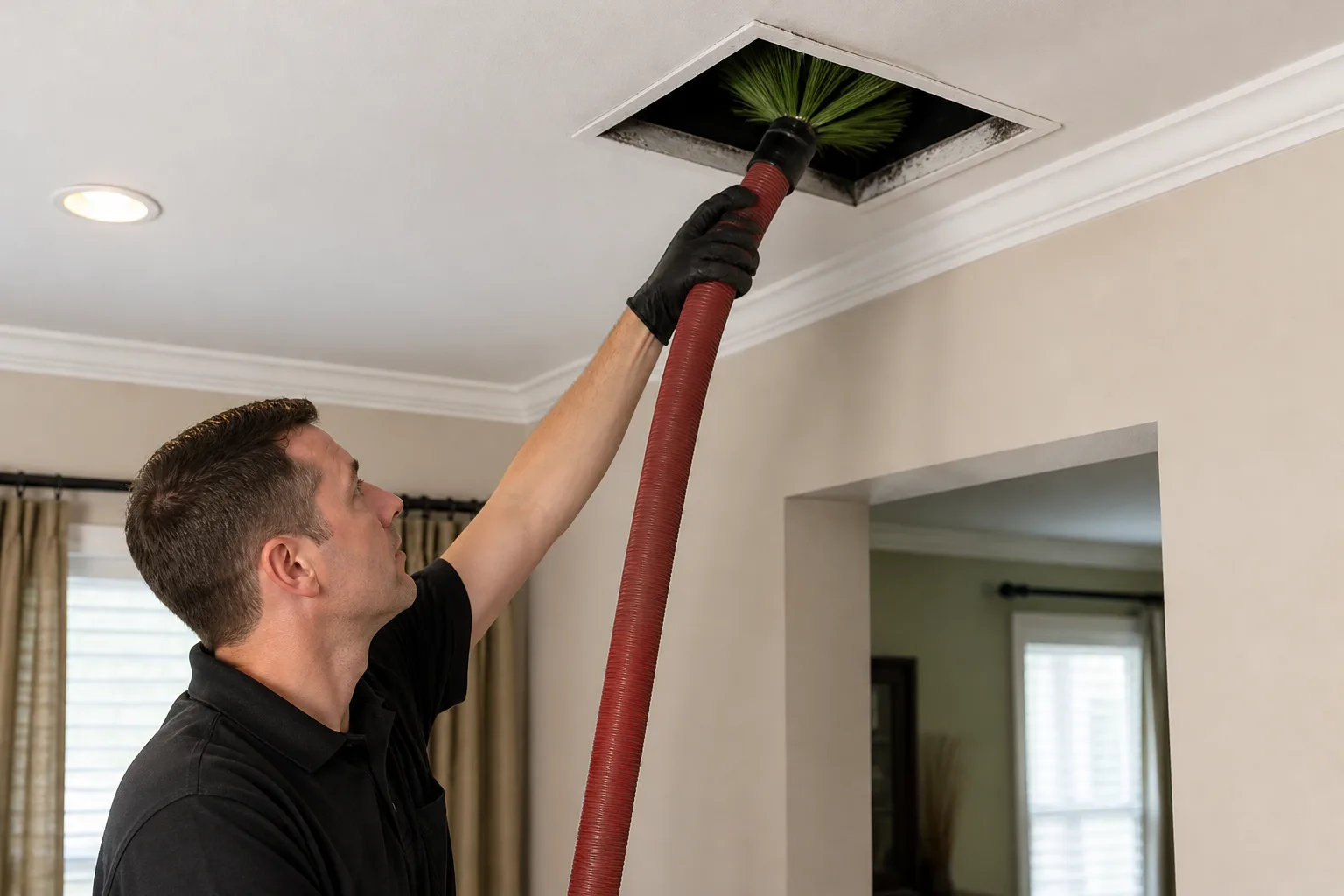
A Rotobrush system works on one principle: contact. A rotating brush, or a set of them on a flexible shaft, is fed through the duct run and spun against the interior wall. That agitation is intentional. Dust settles on the metal or flex surface and bonds there, and a vacuum alone will not pull bonded debris off a wall it can’t touch. The brush breaks that bond.
Running alongside is the extraction side. A HEPA-rated vacuum, like the Nikro units we run, holds the loosened debris in a sealed flow and captures it rather than letting it recirculate into the room. Brush agitation without real negative pressure just moves dust around. Extraction without contact just thins the top layer. You want both.
Then comes verification. A camera goes down the run before and after. If a company can’t show you the interior wall on screen, you’re taking the clean on faith. We’re not in the business of faith.
Which Duct Materials Rotobrush Suits, and Where It Can Do Harm
This is the part most homeowners never hear: the method has to match the material. A rotary brush is excellent on one type of duct and genuinely risky on another.
- Rigid galvanized steel ductwork: The gold standard for Rotobrush. The metal wall is hard, smooth, and handles brush contact well. Lift the bonded dust off, flyover with the vacuum, done.
- Older fibrous or insulated duct liner: This is where a rotating brush demands care. Interior liner, particularly the older sprayed-on or encapsulated materials, can fray, degrade, or shed under aggressive agitation. A trained operator uses the correct brush stiffness and knows when to stop.
- Unsealed flex duct connections: Flex runs have to be inspected before any brush goes in. A loose collar or a torn inner liner needs attention first. Pushing a spinning brush through compromised flex can widen the tear.
The honest answer to “is Rotobrush right for me?” is: it’s right for most homes with rigid metal trunk-and-branch systems, and it needs a materials inspection beforehand on older or mixed systems. A company that can’t tell you what your ducts are made of before they fire up the machine is guessing.
Why Newport News Homes From the 1970s Through the 1990s Are Common Rotobrush Candidates
Duct construction goes through eras. The way a run was built in the 1970s is not the way it was built in the 1990s, and not the way it’s built now. Newport News has a lot of homes from that middle stretch, and those homes tend to share a few duct characteristics that put them squarely in Rotobrush territory.
Through much of that period, rigid galvanized trunk-and-branch layouts were standard, with long horizontal runs under slab or through attic space. That’s a material that takes well to rotary brushing. What those runs didn’t always get was a sealed, filtered return path. Decades of ordinary living, filters swapped inconsistently, a few renovations that opened up framing cavities into the return, and the interior walls carry more load than anyone expected when the house was built.
That’s the honest version. The ducts aren’t inherently bad; they’ve simply been collecting the same way any unopened system collects. Newport News homeowners who’ve owned a 1980s build since the beginning usually know exactly when the last clean was, and for most, the answer is never. Peak air quality starts with an honest look at what’s actually in the run.
What to Look For in Before-and-After Camera Footage
“Clean” is a word. Camera footage is the evidence. Most homeowners don’t know what good footage looks like, so here’s the short version.
Before footage: You’re looking for the interior wall to show visible edges and the duct’s actual color, whether that’s bright silver on steel or the distinct texture of flex material. Darkness, matte buildup, and a felt-like surface are all signs of settled, bonded debris. You’re not looking for a horror show – just the honest state of the wall.
After footage: The wall should show its original surface, edges crisp where the brush has run, and no loose material clouding the run. Note the word after: the debris is gone, and the interior reflects that. If the “after” shot looks like soft focus in a dark tunnel, ask for another clip.
One more check: watch that the same run appears in both shots. A company with nothing to hide will happily show you the same stretch of duct, before and after, in one continuous scene. If the two clips look like different houses, that’s worth asking about. You’d want before-and-after photos of your ducts specifically, not a stock set pulled from the last job.
How to Verify a Company Is Running a Real Rotobrush System
The name Rotobrush is easy to say. A hand-held spin brush from a home-improvement aisle is not the same piece of equipment, and you deserve to know which one is showing up at the door. Ask these questions before you book:
- “Can you show me the machine before we start?” A real Rotobrush rotary-brush system is a substantial unit with a control box, a flexible shaft, and a brush set. It bears no resemblance to a cordless handheld brush you’d buy for ten dollars.
- “What vacuum are you running alongside it?” The brush does the agitating; the vacuum has to capture. We run Nikro HEPA-rated vacuums for this reason. If the answer is “our standard shop vac,” the capture standard is not there.
- “Are you setting up a negative-air containment?” Rotobrush work is not a whisper. Dislodged material is real, and contamination control is the difference between a clean job and a dusty afternoon. Our Abatement Technologies negative-air equipment is the same class of machinery used in professional remediation work, and it holds the work area to that standard.
- “Can I see the camera footage run by run?” If the answer is anything other than yes, the verification step is missing.
- “What brush heads are you using in my system?” Different stiffness, different run. If the operator can’t speak to the material, they haven’t looked at the material.
These aren’t trap questions. They’re the same questions a good operator asks themselves before opening the first run. A trained crew, one with up to 11 years of technician experience, will walk you through each answer without hesitation.
When to Call a Pro, and Related Services in Newport News
Some homeowner inspections are worth doing yourself. Pull the return grille, check the filter for a snug fit, and look at the visible duct for obvious gaps or detached flex. That’s a five-minute look. The moment your inspection turns up a loose connection, an interior liner that’s shedding, or a run you can’t reach, that’s a repair question, not a cleaning question, and the wrong brush in the wrong system can turn a fixable duct into a costly one.
That’s why we treat repair as a core service, not an afterthought. If we find a compromised flex connection or an unsealed joint while we’re cleaning, we can address it on the same visit rather than hand you a list and drive off. We clean it and, if needed, fix it. For a deeper look at the service itself, our air duct cleaning page covers the full process. If the lint trap on the dryer side is on your list, dryer vent cleaning is the other half of a healthy home ventilation setup. And for a broader look at the area, our Newport News page ties the services together.
If a full indoor-air improvement is the goal, the cleaning is the base layer. From there, Aprilaire and Honeywell filtration and air-quality solutions can be discussed and installed by the same specialist, so the clean becomes a long-term upgrade rather than a one-time reset. A word to the wise: filth hides well, and that’s exactly why the camera matters.
What happens when you call
- 1
A real person answersNo phone trees – you reach a local pro.
- 2
You get an upfront price rangeHonest numbers before anyone is dispatched.
- 3
A background-checked tech heads outLicensed & insured, dispatched right away.
- 4
You approve before work beginsNothing starts until you say go.
The Bottom Line
The Rotobrush question comes down to three things: does the equipment match your duct material, is it being run with real extraction and negative-air containment, and can the team show you the interior wall on camera before and after. Get those three right and the machine is doing exactly what it’s supposed to. Get them wrong and you’ve paid for agitation without capture. For more on the full offering, visit Denali Air Duct Cleaning. If you’re in Newport News and need help, Denali Air Duct Cleaning offers free estimates. Call (866) 942-7630 to schedule one. We answer 24/7, with fast dispatch from 7am to 7pm, Sunday through Friday.
Frequently Asked Questions
No. Rotobrush is one method of air duct cleaning, a rotary brush plus vacuum extraction system. Air duct cleaning is the broader service. Good air duct cleaning may use Rotobrush, hand tools, or a combination, depending on the duct material and the contamination level. The Rotobrush is the tool, not the whole job.
Not if it’s run correctly on the right material. Rigid galvanized steel takes to rotary brushing very well. Older fibrous liner and unsealed flex connections need a gentler approach or a materials inspection first. The risk comes from skipping that inspection and forcing a stiff brush through a system it wasn’t made for. A trained operator sizes the brush to the material, not the other way around.
We can give you a general read from the home’s era and duct type over the phone, but the real answer comes from seeing the system. A free estimate includes a look at the ducts and a discussion of what the interior wall camera shows. Without that, anyone promising you a result is guessing. Call (866) 942-7630 and we’ll walk through what you’ve got.
There’s no fixed schedule that fits every home. Homes with pets, recent renovations, allergy concerns, or a long stretch since the last clean tend to need it sooner than a newer build with a well-sealed system. Rather than quote a number of years, we look at what the ducts show on camera and give you an honest read. If it’s due, it’s due. If it’s fine, we’ll tell you.
Usually because the equipment or the scope differs. A hand-held spin brush and a shop vac is not the same job as a full Rotobrush rotary system running alongside a HEPA-rated vacuum with negative-air containment. Cheap quotes often skip the camera verification and the containment setup. Our price is set per job by a written estimate agreed before we start, with before-and-after photos of your ducts, so what you’re paying for is what you’re getting. Call (866) 942-7630 for a free estimate.
Written by the team at Denali Air Duct Cleaning.
Need Air Duct Cleaning Help?
Call Denali Air Duct Cleaning - licensed & insured, here with fast help in Newport News.
(866) 942-7630